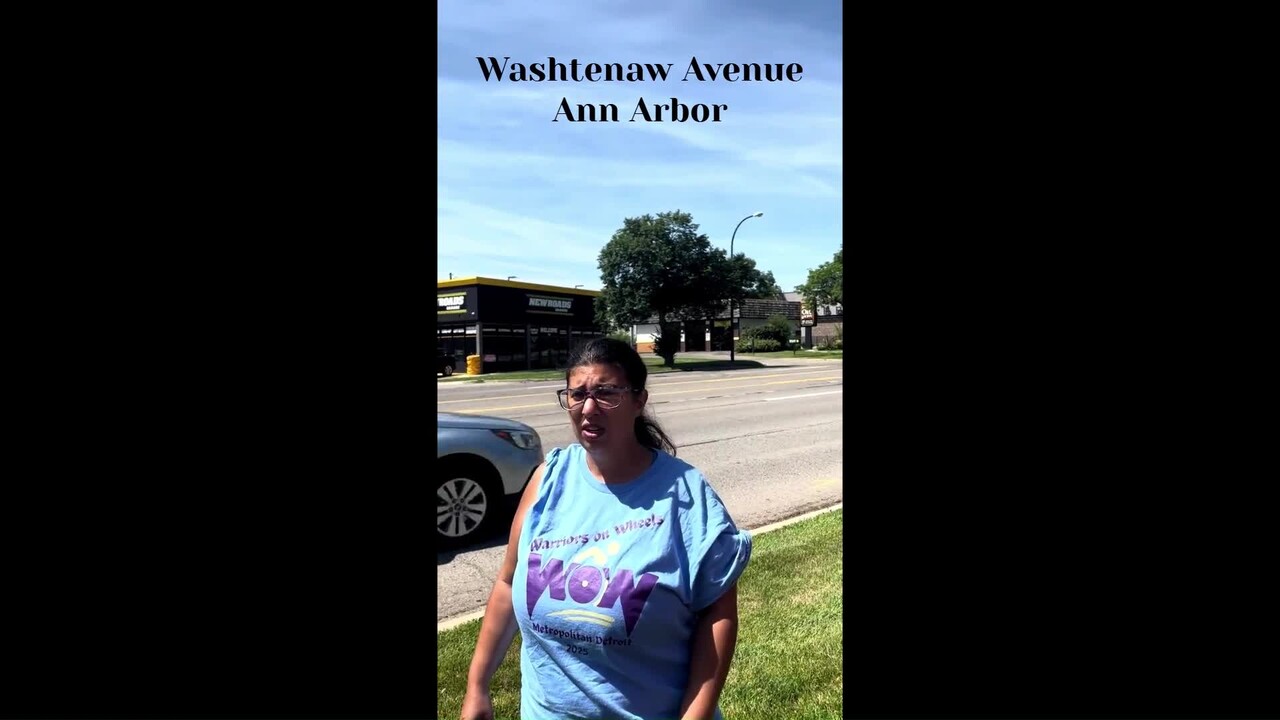
The project examines the potential benefits and harms of artificial intelligence to support people with developmental disabilities, their families and direct-care workers. Researchers are working with Delaware's Division of Developmental Disability S...
STPP Alum Michael Redmond's OpEd on how San Francisco should be taking responsibility for the damage local companies like OpenAI and Anthropic are doing across the country was recently published in the Examiner.
A day-long Symposium on AI, Data Centers and the Climate Change Challenge took place on October 30, 2025. The event, co-sponsored by STPP, was launched by Shalanda Baker, U-M’s inaugural vice provost for sustainability and climate action and professo...
The Michigan Daily wrote about STTP's recent panel discussion about the importance of technical experts working with civil society organizations to serve the public. The webinar, titled “Making Technology Work For Everyone: Empowering Civil Society a...
As artificial intelligence technologies proliferate in industries across the globe, governments around the world are working to regulate how and when these technologies are used. In October 2023, President Joe Biden signed the Executive Order on Safe...
Alexa White, an STPP Certificate and Ph.D. student in ecology and evolutionary biology, was given the inaugural FAS Policy Entrepreneur Award by the Federation of American Scientists (FAS) at a ceremony in Washington, DC on November 16, 2023. Accordi...
Esha Mathew (PhD '15 - Cell/Cellular and Molecular Biology) is a Foreign Affairs Officer in the Office of Science and Technology Cooperation at the U.S. State Department. Previously she was a Science and Technology Fellow with the American Associatio...
Johanna Okerlund is an STPP postdoctoral fellow working on the Rethinking Computer Science Education: Bringing Public Interest Technology into Undergraduate and Postdoctoral Training project. Dr. Okerlund, whose background is in computer science, wil...
Please join the Science, Technology, and Public Policy Program for "Making Technology Work For Everyone: Empowering Civil Society and Technologists to Work Together to Shape our Future," a webinar about the importance of bringing together technical experts with civil society organizations.
Attorney Vineet Shahani, General Counsel and policy and corporate development lead for Mill, will engage with current STPP students in an informal conversation about his background in technology policy and climate work. Mr. Shahani will provide valuable insight into the daily operations of policy work in a tech company, as well as the pragmatic aspects of seeking policy jobs in Silicon Valley.
This slideshow serves as an interactive workshop on the scope of mass surveillance in the United States, particularly in Detroit and other urban communities. It is meant to explore surveillance's effects on privacy, policing, and community life. Medi...
Madeleine Gibbons-Shapiro, Master’s in Public Policy ‘27
Recent operations of U.S. Immigration & Customs Enforcement (ICE) have revealed an extensive web of surveillance technologies and databases of private information that ICE uses to track, arrest, and deport people. ICE contracts with private companies...
Madeleine Gibbons-Shapiro, Master’s in Public Policy ‘27
Every polling place in the United States is required to have an accessible voting machine. Here in Michigan, they are called Voter Assist Terminals, or VATs. A Voter Assist Terminal (VAT) is an accessible, touch-screen device available for voters to ...
John Blake, MPP and MS, Environment and Sustainability
Executive summaryThis memo briefly describes what assistive technology (AT) is; summarizes how it differs from other accessibility terms; compares the different types of AT; and outlines the legal structures and barriers for supporting and using AT i...
Law enforcement agencies in Michigan are increasingly using drones as a common tool for purposes including surveillance, crime prevention, and search and rescue operations. Privacy concerns loom large as drones capture images and videos of individual...
This Technology Assessment Project report anticipates the social, environmental, ethical, equity, economic, and geopolitical implications of widespread adoption of advanced nuclear energy technologies, especially small modular reactors (SMRs), using ...
Shobita Parthasarathy talks to Nature's "Stick to the science" podcast as they look back at the history of the knotty relationship between science, politics and power. November 2020.