
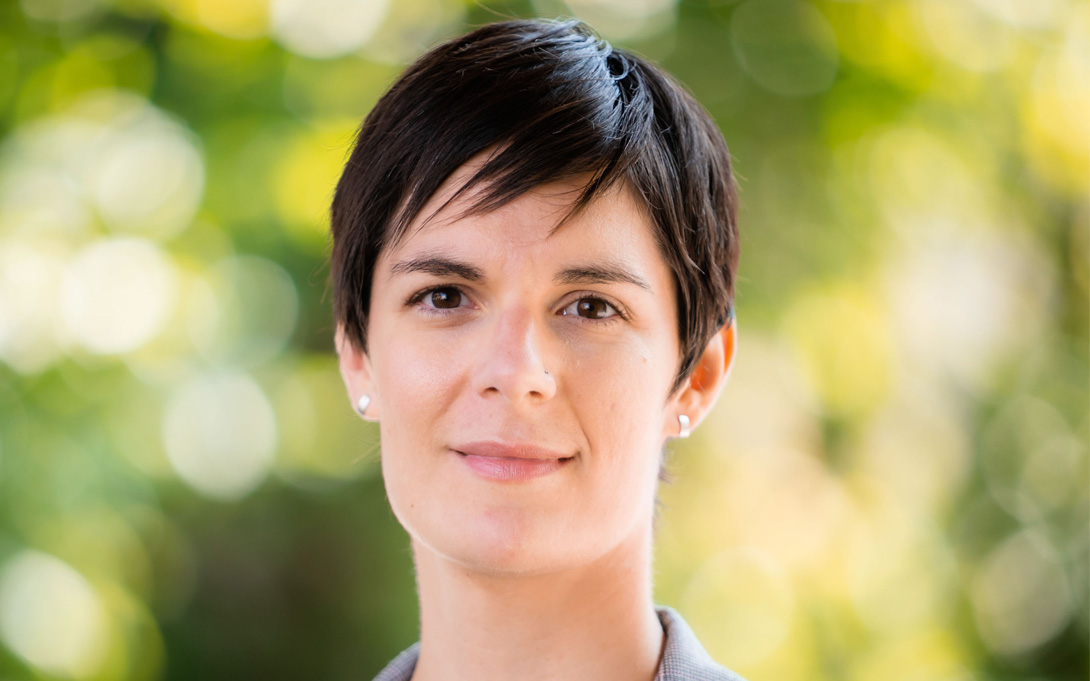
STPP faculty affiliate Denia Djokić is an Assistant Research Scientist at the Fastest Path to Zero Initiative. Concurrently, Djokić is also a 2021 Levenick Resident Scholar in Sustainability Leadership at the University of Illinois at Urbana-Champaign.
Djokić assists the Fastest Path team in grounding approaches to zero-carbon energy system deployment in principles of social equity and environmental justice. She provides expertise and guidance in engaging with stakeholders and communities potentially impacted by the deployment of advanced nuclear energy technology. She recently answered some questions about her work and career path.
Your career has been particularly international. What was your path to the work you do now?
It’s hard to separate the personal from the professional—my life has always been international, and my career has followed that same path. I was born and raised in Vienna, with one side of my family from Serbia and the other from the United States and Austria (with since then many other nationalities joining in as the extended family expands!). I moved to the US to study physics at Carnegie Mellon University before pivoting to nuclear engineering for graduate school at UC Berkeley, focusing on radioactive waste management. Because nuclear energy is historically a globally developed and governed technology, I found myself working across borders and alongside colleagues from all over the world early on, even while based at U.S. institutions.
Later, I shifted to policy when I moved to Quito, where I served as a science policy advisor for the Ecuadorian government. That work sometimes included energy and nuclear-specific issues, but mostly stayed broad in scope, encompassing many aspects of science and technology policy for research and higher education. In that position, I was immersed daily in the politics and governance of science and technology in an incredibly dynamic context. While my experiences in Ecuador echoed broad themes I encountered as a student studying complex sociopolitical issues like radioactive waste disposal, there I developed an especially deep appreciation of how tightly knowledge and power are intertwined and how important it is to design S&T policy alongside social policy. Eventually, I returned to the US for a postdoctoral fellowship at the Harvard Kennedy School, which helped me translate my intuitive, lived experiences into formal academic frameworks, such as those of science and technology studies (STS). This combination of international experience and academic grounding shapes my research today.
What are you focusing your research on now?
I am back to focusing on nuclear energy issues, though now in an explicitly interdisciplinary capacity. My current research brings together various strands of technical, policy, and social science training to critically examine nuclear energy and radioactive waste management, with the goal of shaping policy and governance frameworks. I lead or support research projects such as the Technology Assessment Project (TAP) on the implications of advanced nuclear energy discussed below, community engagement in advanced nuclear energy facility siting in Wyoming, and community consent and collaboration in the co-design and siting of nuclear waste storage. Across my research projects, I attempt to integrate STS principles, tenets of environmental justice, intersectional feminist lenses, and attention to power dynamics. While there are limits depending on the project and political context, I aim to foreground the social dimensions or unintended consequences of technologies and research design decisions that are often overlooked. By broadening how technical problems are understood, I want to help ensure that technology development advances equity and accountability over profit or unsustainable growth, and to caution against using technology as a substitute for more effective societal interventions.
Can you tell us about the Technology Assessment Project you are working on with STPP and how you got involved?
Yes! I first heard about STPP’s Technology Assessment Project (TAP) from Todd Allen, the chair of the Nuclear Engineering and Radiological Sciences (NERS) Department and director of the Fastest Path to Zero Initiative, who encouraged me to read STPP’s report on facial recognition in schools. In subsequent conversations with Molly Kleinman and Shobita Parthasarathy, we agreed that conducting a technology assessment for advanced nuclear energy was a timely and worthwhile endeavor given growing global attention to this “new” version of nuclear energy. Not long after, our interdisciplinary NERS/STPP team received a grant from the UM Graham Institute for Sustainability’s Carbon Neutrality Accelerator Program and the Michigan Memorial Phoenix Project as well as funds from the Alfred P. Sloan Foundation to support the work. I feel very lucky to have gotten involved with STPP, to have received such generous support to enable this unique research project, and to have been working with an amazingly brilliant and creative research team for the past couple of years.
Our TAP project on advanced nuclear energy, with a focus on small modular reactors (SMRs), anticipates the societal implications of this emerging energy technology. Using the analogical case study (ACS) approach developed by Shobita, we examined dozens of historical cases of technology in society that resemble SMRs in function or potential impact. From these case studies, our team identified the consequences from the uptake and use of each technology. In simple terms, history repeats itself—so by learning from these cases, we can make predictions about the social, geopolitical, economic, ethical, and equity dimensions of widespread SMR deployment. With our analysis, we aim to inform governance frameworks early—before harms are entrenched—so benefits can be maximized and risks can be mitigated before the technology is widely implemented. This work feels especially urgent right now, as governments and companies aim to meet the rising energy demands of population growth, urbanization, and data centers. While advanced nuclear energy promises reliable and carbon-free electricity generation and solutions to the long-standing challenges of conventional nuclear power, our technology assessment expands the political debate toward a broader systems-level analysis. Stay tuned for our full report, The Reactor Around the Corner: Understanding Advanced Nuclear Energy Futures, which will be published this fall!
How do you see your work intersecting with STPP's in addition to the TAP project or in the future?
STPP’s mission is to advance the public interest by situating science and technology within their broader social, ethical, and political contexts, with explicit attention to social equity and justice. This aligns closely with my approach to nuclear energy and waste. Beyond TAP, I see a lot of opportunities to connect my work with STPP’s broader agenda—for example, examining how low-carbon energy systems intersect with equity and environmental justice, or exploring the governance of energy-intensive infrastructures such as data centers. STPP provides an invaluable space where this kind of research and education can continue, which is urgently needed at a time where such opportunities are becoming both scarcer and more critical.
What advice would you have for a student who is interested in following your career path?
It can be difficult to follow an unconventional career path, especially when personal circumstances leave little room for flexibility. There aren’t established rules or clear metrics of “success”, and sometimes your interests or politics may not make sense to others, except perhaps to those with similarly winding trajectories. That can feel discouraging, and at times you may want to give up.
But the upside is that these idiosyncratic paths often create opportunities to connect people and fields that don’t usually interact. That, in turn, can produce the knowledge and action that this world badly needs. If you’re drawn to that kind of work, it is worth the uncertainty. Be open to non-conventional job opportunities that will enrich you over the long term. Seek out mentors who understand the value of interdisciplinary or international experiences, and trust that your unique perspective is an asset.
Anything else you would like to add?
I feel incredibly fortunate to be part of a community that values rigorous research and centers the public interest. Work on energy, technology, and justice often feels daunting because the problems are so large and complex, and the systemic rigidities to implementing meaningful changes are real. But it’s also deeply encouraging to see how much creativity and commitment exists in spaces like STPP and I hope that its work can inspire more institutions to build more thoughtful and equitable approaches to science and technology policy.