
By Shuhaib Nawawi, PhD Candidate at SEAS
This summer, I participated in the Young Scientists Summer Program (YSSP) at the International Institute for Applied Systems Analysis (IIASA) in Laxenburg, Austria, an institute founded in 1972 to foster collaboration on complex global challenges. Along with 48 other doctoral researchers from across the globe, I was part of a cohort tackling projects that ranged from carbon management and energy transitions to issues of marine biodiversity, freshwater stress, and transboundary haze pollution.

© Matthias Silveri
I spent much of the summer advancing a chapter of my dissertation under the guidance of IIASA mentors, but the experience gave me far more than research progress. Through weekly exchanges on the philosophy and practice of systems analysis, I began to see that methods and models are not neutral tools but reflections of the values and worldviews brought to them—and that these assumptions shape what we notice, what we measure, and even what we believe can be changed.
Before YSSP, my training in energy modeling led me to view systems largely in terms of optimization—how to reach an objective by adjusting variables within constraints. But as I engaged with IIASA’s broader systems community, I came to see that not all systems can, or should, be optimized. Many persist and evolve through feedback, resilience, and adaptation—much like the ecosystems that sustain us.
Two workshops stood out as particularly formative in helping me grow as a policy-oriented researcher. The first, a Political and Diplomatic Negotiation workshop led by Dr. Paul Meerts, simulated the realities of international decision-making, where dialogue and persuasion must navigate competing interests and imperfect information. Through exercises on perception and a mock multiparty negotiation, we saw that meaningful progress often requires compromise; sometimes you have to give up something to gain something more important. The workshop underscored that effective policy work is not only about analytical rigor but also about building coalitions, fostering trust, and finding alignment amid disagreement.
The second was the Decision Theory and Science Policy workshop led by Dr. Daniel Goroff, Vice President of the Sloan Foundation and former advisor at the White House Office of Science and Technology Policy. Building on the ideas of decision theorist Howard Raiffa, Goroff challenged us to think critically about how every choice—whether in research, policy, or life more broadly—involves navigating trade-offs between evidence, values, and uncertainty. He emphasized that good policy advice is not just about presenting data; it’s about showing, at every step, how evidence, judgment, and values work together in shaping a recommendation.
The summer was equally enriching on a personal level. Conversations with peers from 27 countries, along with researchers from the wider IIASA community, revealed not only new ideas but also new ways of seeing how research is shaped by the places, histories, and constraints we inhabit. Talking with a Ukrainian colleague navigating her research in the midst of war reminded me how unequal the conditions for doing research can be, and a Nigerian scholar’s study of gendered inequalities among waste pickers in Lagos opened my eyes to issues I had never before considered.
I also came to see how familiar questions from my academic training take on new meanings across contexts—from energy equity debates in Sweden to renewable-aligned data centers in China and urban transformation efforts in the Czech Republic. These exchanges pushed me to look beyond the modeling world and connect quantitative analysis with the lived realities it seeks to represent. They reminded me that systems thinking, at its best, engages not only with data and feedback loops but also with people, institutions, and social structures that shape them .
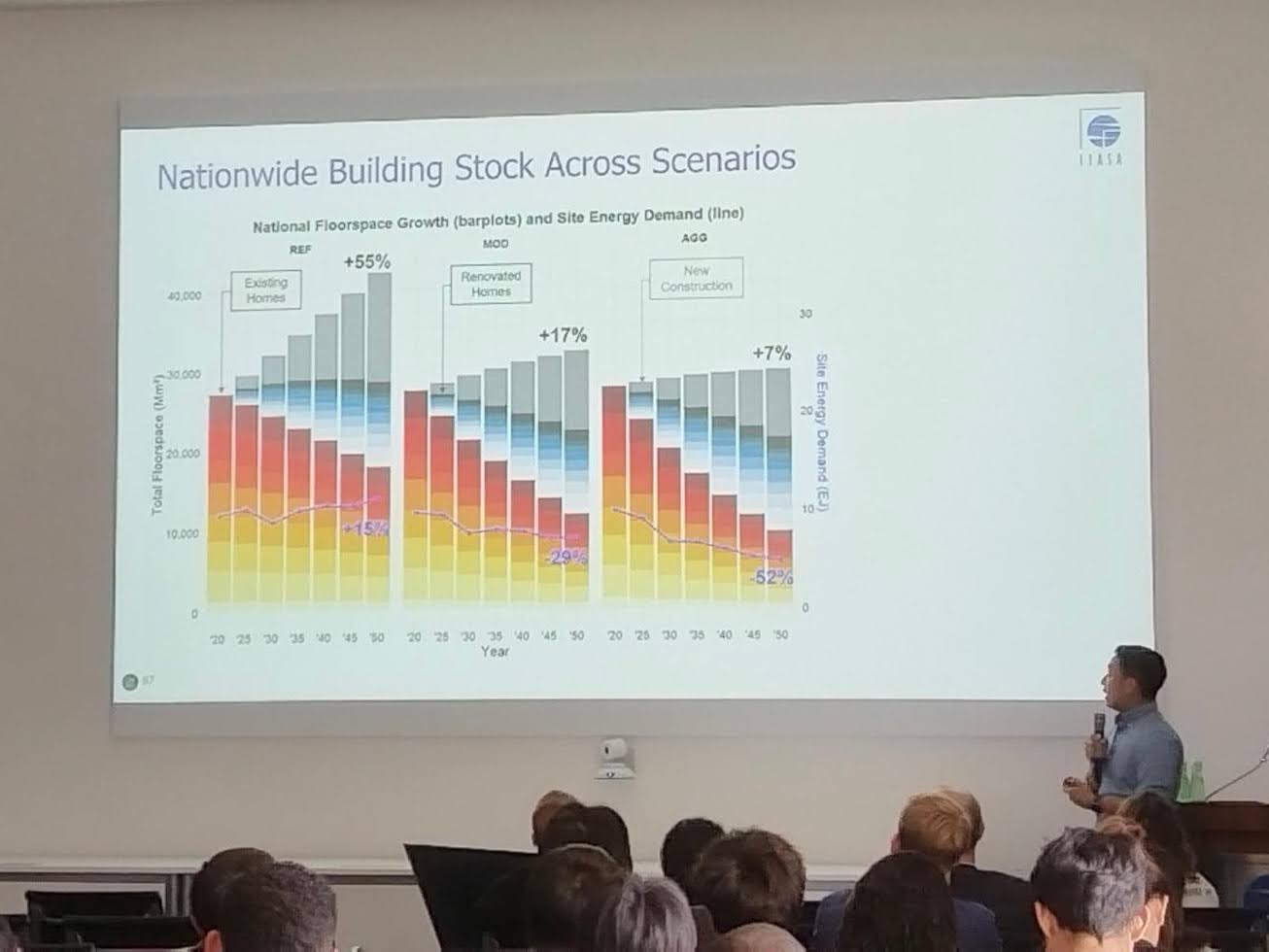
After an intense summer of research, discussion, and collaboration, we concluded the program by presenting our projects to the broader IIASA community. By then, I had not only advanced my dissertation but also reimagined what it means to do systems research, bridging models and lived realities, evidence and values, analysis and empathy. The relationships and conversations formed at IIASA continue to shape how I think, work, and grow. I am deeply grateful to the STPP Student Development Grant for partly supporting this opportunity to develop as both a scholar and a person.