
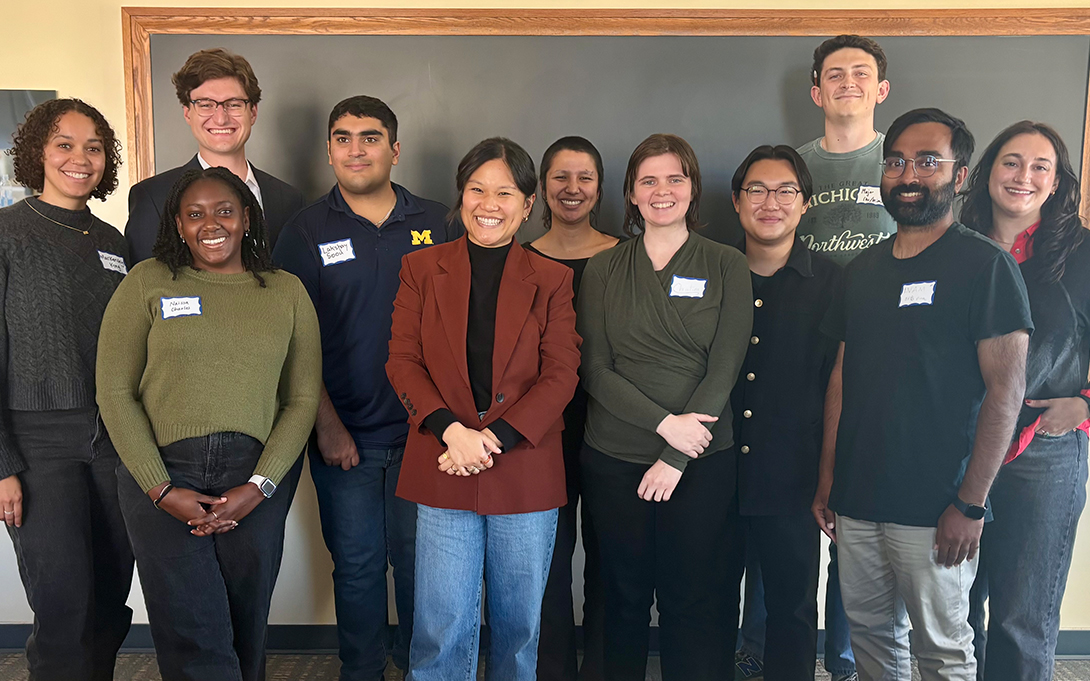
I had the opportunity to meet Karen Hao, author of the bestselling book Empire of AI, who came to the Ford School for a special conversation with students in October.
Hao's bottom line: Beyond GenAI's sleek public interface lies a more intentional purpose. Big Tech companies are deploying these large language models (LLMs) to extract resources and avoid accountability.
ChatGPT & the Ford School effect
Initially, using ChatGPT felt surreal. Its responses were highly convincing but highly inaccurate, leading me to realize that ChatGPT was making assumptions, many of which reflected preconceived notions about different groups of people. For example, it generated a white man when I asked for an image of a lawyer for a class presentation. Encountering such bias in AI cultivated my interest in AI regulation.
Enter the Ford School Effect—my interest in AI policy grew after listening to Ford School professor Shobita Parthasarathy lecture in PUBPOL201 on governing AI and reclaiming our control over it. During this lecture, I learned that AI is not just a technical system but a sociotechnical one, meaning that human choices, values, and policies deeply shape its design and impact. I realized that AI policy must foster innovation that uplifts people rather than displacing them and that effective AI governance demands democratic participation, not just technical expertise.
Hao's overview of AI justice in the Global South
While at the Ford School, Hao shared her perspectives on national security, data centers, environmental justice, and personal agency. The Empire of AI, which isn't just a book title, describes a new global order dominated by powerful tech companies, mainly OpenAI, which seize data, labor, and natural resources—like the way European colonialists did—to build and control this technology to gain greater wealth and power under the guise of serving humanity.
Hao shared that the Empire of AI's exploits spare no one. She referenced Sama, a Kenya-based data content moderation company partnering with OpenAI. Sama's workers were paid one dollar an hour to review obscene content, training ChatGPT not to include it in its answers. In Cerillos, Chile, Google's proposed data center would have consumed over 1,000 times the community's annual water use, and that during one of Chile's worst droughts. Hao suggests that an international agreement, such as the Bangladesh Accord on Fire & Building Safety, enacted after a deadly building collapse in Dhaka, is needed to govern the international allocation of resources for AI and to protect AI workers' labor rights.
Hao offered a positive alternative for a "different kind of AI system" In New Zealand, called Te Hiku Media. This human-centered initiative uses AI to revitalize te reo Māori, an indigenous language nearly wiped out by colonial schooling and assimilation policies. She mentioned that, unlike OpenAI's extractive model, this model is rooted in consent, reciprocity, and data sovereignty, meaning that Te Hiku's creators sought elders' permission before collecting training data to ensure full transparency. This exemplifies Hao's belief that AI can be beneficial when people have control over it and when it serves communities.

Why wolverines should care about AI policy
As Fordies, U-M students, and members of the University community, we all need to understand that AI policy is a nuanced topic, with many benefits and drawbacks to adopting this technology. Instead of being passive consumers of ChatGPT, Wolverines must become informed to shape an ethical AI future. Ultimately, understanding AI's global impact and the need for equitable governance will enable us to advocate for AI governance and technology grounded in the communities they serve. The next time you're tempted to use ChatGPT to write your paper, think about what makes that instant answer possible, as under the hood, these models are "monstrosities built from consuming previously unfathomable amounts of data, labor, computing power, and natural resources (Empire of AI page 26)."
Lakshay Sood is a third-year BA student at the Ford School of Public Policy interested in the intersection of AI policy and economic policy. This summer, he served as a Technology Policy Intern for his home state governor, Michelle Lujan Grisham, in New Mexico, where he wrote policy recommendations to optimize Microsoft Copilot AI to improve constituent services and make them more efficient and equitable. On campus, he is involved in multiple student organizations, including LEAD Now (Leaders for Ethical AI Development Now), Central Student Government, French Club, the Ford Leadership Forum, and Indian Students Association.
More news from the Ford School