
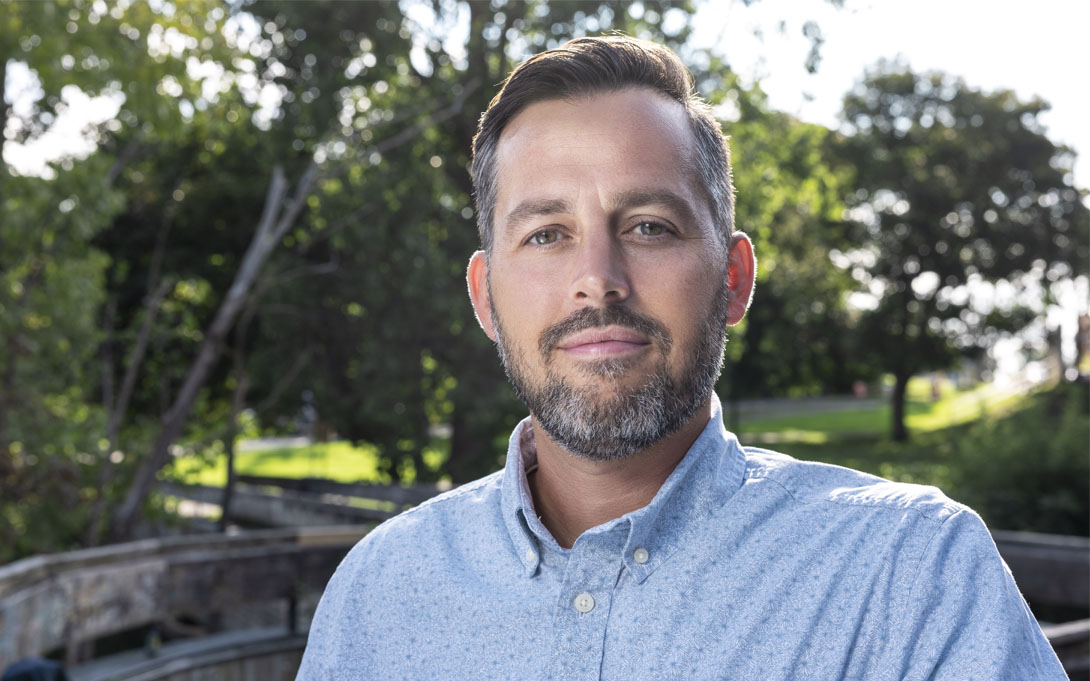
STPP faculty affiliate Paul J. Fleming is an Associate Professor in the Department of Health Behavior & Health Equity at the School of Public Health. His work focuses on the root causes of racial health inequities and policy and programmatic strategies to address them. He conducts community-based participatory research focused on the health needs of Latinx immigrants in Michigan and examines how to best integrate anti-racist principles into public health training and practice. His book, Imagine Doing Better: Why Policies Backfire and How Prevention Thinking Can Change Everything, will be released on October 14.
He recently answered questions about his upcoming book, career path, research interests, and intersections with STPP.
What was your path to the work you do now?
My time as a Peace Corps Volunteer in Nicaragua was foundational to the path I’m on today. It taught me both the importance of building strong relationships and prioritizing community-led solutions to local problems. It also introduced me to the field of public health. Over the past two decades, I’ve developed work in partnership with local communities that aims to leverage community strengths to solve pressing problems related to health, broadly defined. In this work, communities often identify public policies at the local, state, or federal level that impact their health and well-being. As a professor in the School of Public Health, I see my role as being a good partner to people trying to improve their communities and helping to train the future public health workforce to better support community-led change.
Your new book is Imagine Doing Better: Why Policies Backfire and How Prevention Thinking Can Change Everything. What are some significant problems that public policy experts are getting wrong and led you to the conclusions in your book? Can you give some examples of some problems that need to be addressed differently?
So many of our public policies are aimed at addressing a problem after it occurs rather than using prevention thinking. Prevention thinking invites us to identify the root causes and listen to local communities to create policies that prevent the problem in the first place. Our public policies to address crime in this country are mostly oriented around punishing people after they have caused harm to someone else. We spend billions of dollars on punishing people. What if we re-oriented our thinking and thought about investing that money into the root causes of crime? This shift in thinking could lead us to make crucial investments to create jobs, enhance mental health supports, or build affordable housing. Another example is our health care policies in this country. We spend vast amounts of money on health insurance to pay for healthcare services after people get sick, but only spend a tiny fraction of that on helping people stay healthy. Using prevention thinking would help us reorient our policies towards creating communities that fostered and promoted health and helped to prevent problems in the first place. Our public policies are too often reactive rather than proactively creating a better society where people are healthy and can thrive. Beyond identifying some of the problems with our current policies, Imagine Doing Better also offers readers a roadmap for action towards a future with better policies for all.
For what audience is this book written? Why?
I wrote this book for folks who are do-ers, leaders, or changemakers in their communities. These are the people who know that a better world is possible and want to take action to help us get there. Imagine Doing Better aims to give those readers a lens through which to see our current society and a roadmap for how we take action together to build a better future. From my work with community-based organizations and organizers, I felt there were so many lessons about working towards better policies and a better world that were not reaching a broader audience. I wrote the book to help readers think about the actions needed to improve our policies. The book is in conversation with other recent books like Viral Justice by Ruha Benjamin and Abundance by Ezra Klein & Derek Thomas to help readers think about how to get unstuck from the problems plaguing us today and allow ourselves to imagine—and pursue—a better world.
What else are you focusing your research on now?
Currently, I’m focusing my work on institutional transformation. How can we connect institutions and local communities to help institutions change their policies and practices to better meet people’s needs? I do this specifically through a few different projects. First, I’m partnering with a community in Detroit to help health care institutions better meet Spanish-speaking clients’ needs. Second, I’m working with a local health department and local community members to help create a process for assessing institutional policies and practices with an equity lens.
How do you see your work intersecting with STPP's now and in the future?
STPP is a leader in thinking about community partnerships to advance policies that promote equity and justice and my own work is in that space. I look forward to continuing to be in conversation with the STPP community as we collectively try to innovate and create policies for a better future.
Anything else you would like to add?
You can learn more about my book here. I look forward to hearing from the STPP community on how the ideas in the book intersect with your own work and perspectives!
